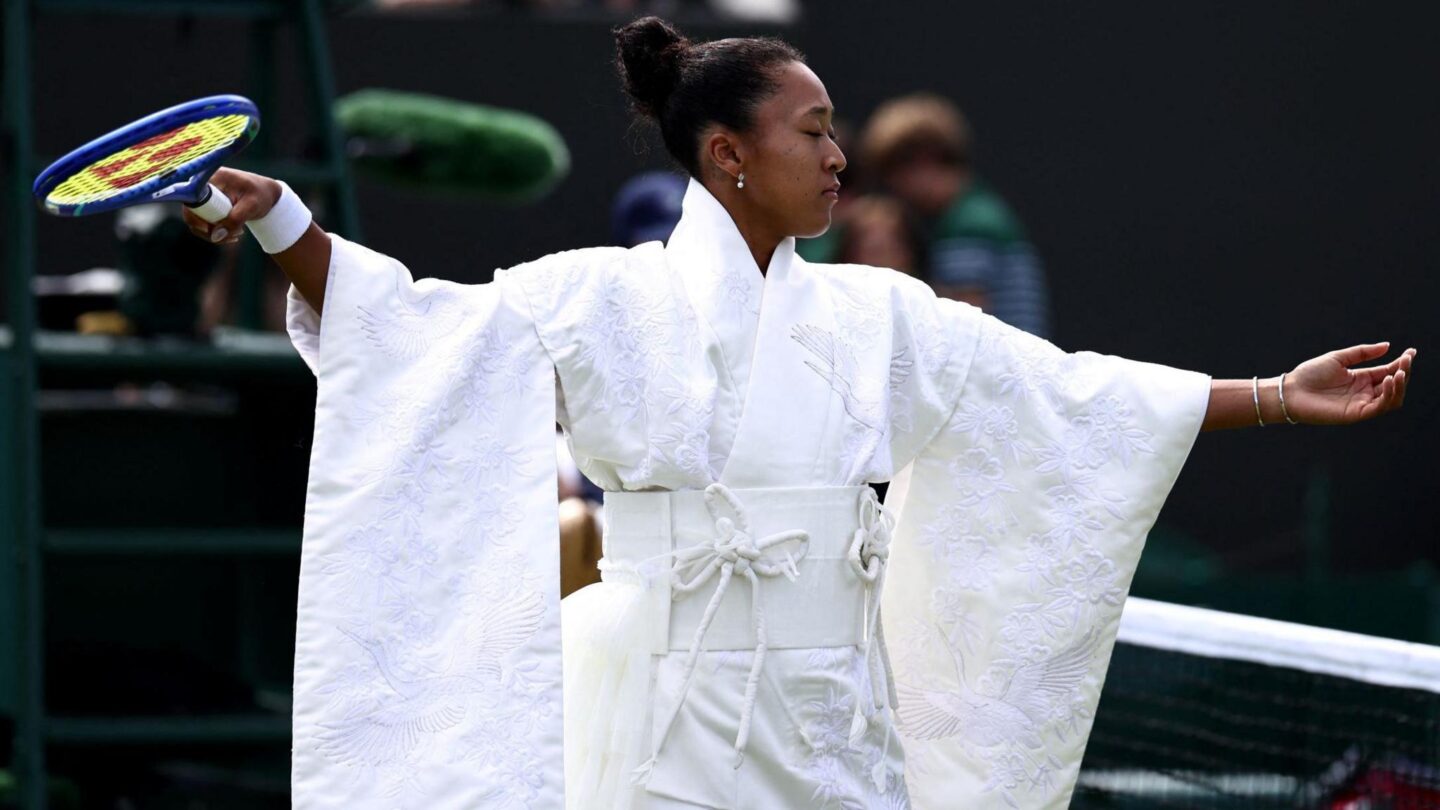
There is a version of this story where Naomi Osaka’s run to the Wimbledon quarter-finals this year, her best-ever result at the All England Club, is the headline. That is not, however, the version most people are talking about.
Osaka arrived on the grass in a lace kimono designed by Hana Yagi, stitched with cranes and cherry blossoms and finished with a bow across the back, all within Wimbledon’s all-white dress code. It is the latest entry in a run of walk-on fits that have become as much a part of her Grand Slam appearances as the matches themselves: an Ambush-designed black-and-green look inspired by Japanese Lolita goth at the US Open, a jellyfish-esque Robert Wun creation with a parasol and veil at the Australian Open, and gold, Eiffel Tower-silhouetted layers at Roland Garros. Each one draws the same reaction: cameras, commentary, a cycle of takes, regardless of how far she advances in the draw.
That gap between results and attention is exactly what former Roland Garros finalist Anastasia Pavlyuchenkova zeroed in on in a recent interview with Tennis Bolshe. Pavlyuchenkova pointed out that Osaka’s form has genuinely improved, but noted that even in tournaments where she exits early, the outfit still ends up as the story. Her read was blunt: you don’t dress like that and then claim you’re not looking for eyes on you. “She definitely wants attention, because I think when you go out in such outfits, you can’t say later no, no, I don’t need attention,” Pavlyuchenkova said, adding that she nonetheless respects the boldness of it, comparing it to the hesitation she felt wearing a denim skirt-and-jacket combo in Rome last year.
It’s a fair point, and not an unkind one. Osaka herself has framed the outfits as identity and art rather than a bid for headlines, pushing back on critics in blunt terms of her own and saying the looks are made for people who relate to her experience, not for detractors. But intent and effect are different things, and the effect has been consistent: four majors, four viral fits, and a conversation that circles back to fabric and silhouette more often than forehands and results.
Pavlyuchenkova didn’t stop at Osaka. She also raised a question about her fellow WTA pro Aryna Sabalenka, who wears Nike on court but hasn’t received the same custom-outfit treatment despite being the reigning world No. 1. Pavlyuchenkova suggested Sabalenka’s status and personality warrant more from her sponsor than what she called fairly standard kits, and wondered aloud whether some kind of arrangement explains why Osaka gets the fashion-house treatment and Sabalenka doesn’t.
Whatever the reason, the pattern with Osaka is unlikely to change anytime soon. She’s said as much herself, as long as the people who connect with her stay in her corner, the outfits keep coming, tournament after tournament. Whether that’s a savvy piece of personal branding or simply an artist doing her thing in public depends on who you ask. Either way, the wardrobe isn’t losing its grip on the conversation, and neither is the debate over whether that’s exactly the point.
