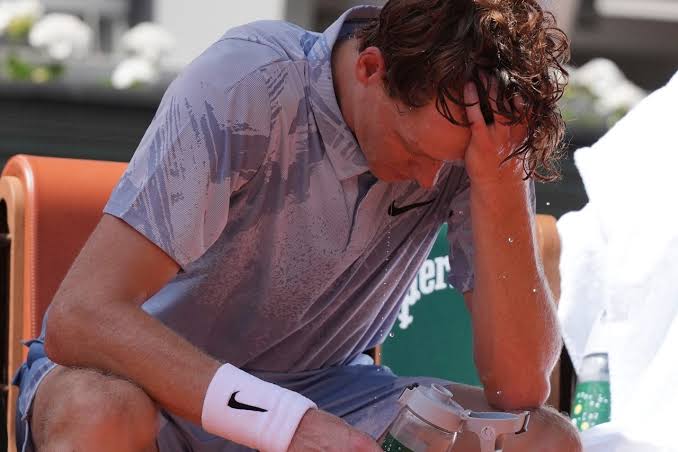
If a guy who trains with a full sports science team, a personalized cooling protocol, and a physio staff on retainer can still get dropped by the heat in a Grand Slam, what exactly is the rest of us bringing to a Tuesday night practice in July? That’s not a rhetorical dig at Jannik Sinner. It’s the whole point.
Sinner is arguably the most physically prepared player in the sport, and the heat has gotten to him more than once on the biggest stages available. He retired mid-match at the Shanghai Masters last October, cramping so badly in his thigh he could barely walk off the court. Months later, at the Australian Open, he was reduced to stretching out cramps in his arms and legs against a qualifier before the tournament’s extreme heat rule bailed him out with a roof closure. Then at the French Open, he was the one holding an ice bag to his neck and fanning himself between points, telling reporters afterward that he woke up that morning already not feeling right, and never really found his footing before losing a two-set lead.
Three different tournaments, three different continents, three different flavors of the same problem. If heat can do that to the number one player in the world, heat isn’t a footnote for the rest of us. It’s a variable that needs actual training, the same way a second serve or a two-hander down the line does.
Most players treat hot weather as an obstacle to survive during a session, not a condition to prepare for before one. You show up, you sweat more than usual, you drink some water between games, and you tell yourself you’ll “get through it.” That’s not heat management. That’s just enduring.
The players who actually hold up when the mercury climbs aren’t the ones with the biggest water bottles. They’re the ones whose bodies have already been taught what to do with heat, days and weeks before it matters. That’s the entire premise behind the idea of heat acclimatization, and it’s a real physiological adaptation, not a mental toughness thing. Your body genuinely changes: your plasma volume increases, you start sweating earlier and more efficiently, and your core temperature climbs more slowly for the same amount of work. None of that happens by accident. It happens because you practiced in it.
Build the heat into your training block on purpose
Here’s the reframe: instead of asking “how do I survive practice in this heat,” ask “how do I use practice to get better at heat.” That’s a different project, and it changes what you actually do on court.
Front-load short, controlled exposure before you need it. If you know a tournament or a big match is coming up in hot conditions, don’t wait until match week to deal with it. Start layering in 20-30 minutes of hitting in the heat of the day, several sessions out, and build from there. The adaptation curve is fast, usually 7-10 days of consistent exposure gets you most of the benefit, but it has to happen before the stakes are real, not during them.
Practice your changeover routine like it’s a stroke. Sinner reaching for an ice bag and a hand fan wasn’t improvisation, it’s a routine elite players actually rehearse. Most club and college players have never once practiced what they’ll do in the 90 seconds between games when it’s 95 degrees. Decide now: where’s the shade, what’s the cooling method, how many sips, how are you resetting your breathing. Walk through it in practice so it’s automatic in a match, not something you’re figuring out for the first time while your legs are cramping.
Track how you actually respond, not how you think you should. Cramping location matters. Sinner’s issues have shown up as thigh cramps, arm cramps, and general dizziness in three separate incidents, which tells you heat stress doesn’t hit everyone the same way twice. Keep a quick note after hot-weather sessions: what cramped, when, how you felt an hour before it started. Patterns show up fast, and they’re specific to you.
Practice recognizing the exit ramp before you need one. The single biggest difference between a heat-related retirement and a heat-related scare is how early it’s caught. Sinner has talked about waking up already feeling off before a match and playing through it anyway. That’s a lesson, not a knock: build the habit in practice of actually stopping when something feels wrong early, instead of pushing through and hoping it resolves. A practice set you cut short is nothing. A retirement in a final is a very public, very avoidable story.
Load the logistics before the weather forces your hand
None of the above works if the boring stuff isn’t already handled. Hydrate the day before, not just the day of, since you can’t out-drink a deficit in the middle of a session. Electrolytes matter more than plain water once you’re sweating heavily for an extended period, since water alone can actually dilute what your body needs to hold onto. Time your hardest practice blocks for the cooler parts of the day when you have the choice, and treat the brutal midday slot as the special-occasion heat-training session it should be, not the default.
Sinner isn’t cramping and retiring because he doesn’t care about conditioning. He’s dealing with heat because heat is genuinely one of the hardest variables in tennis to prepare for, and even elite programs get caught out by it. That should be reassuring, not alarming: it means the fix isn’t some secret pro-level trick you’re missing. It’s just training the thing directly, the same unglamorous way you’d train a weak backhand slice, instead of hoping your competitive fire carries you through 90-degree conditions on adrenaline alone.
Adrenaline runs out. Preparation doesn’t.
